Most lists of AI influencer examples are a scroll of faces and follower counts. That is fine if you are curious. It is not much use if you are building one.
So this is a different list. Seven well-documented characters, who runs each of them, what they are known for, and the one thing each teaches. Follower counts go stale in a month, so we have left them out. The lessons do not.
One note before the names. Several of these were built with 3D tools and digital rendering, years before generative AI made the job quick. People search for them as AI influencers anyway, and the lessons carry over either way. If you want the vocabulary untangled, the synthetic creator page does that.
AI influencer examples, and what each one teaches
1. Miquela: give her a story
Miquela began in 2016 as an Instagram profile. The character is a teenage model from Downey, California. In April 2018 she was revealed to be the work of Brud, a Los Angeles startup. She has released music, taken over Prada's Instagram and appeared in a Calvin Klein advert. Time named her one of the 25 most influential people on the internet in 2018. Dapper Labs acquired Brud in 2021.
The lesson: character. Miquela has a home town, a music career and an ongoing plot. People follow a story. A face with no story is a portrait.
2. Shudu: craft, and credit where it is due
Shudu was created in April 2017 by the fashion photographer Cameron-James Wilson. His studio, The Diigitals, describes itself as the studio behind the first digital supermodel. Wilson has described shooting real models in the clothes and merging those images with Shudu's digital form. Her work includes campaigns for Balmain and Ellesse.
Shudu has also drawn criticism. She is depicted as a black woman and was created by a white man, and that has drawn public criticism.
The lesson: people will ask who is behind the face. Have an answer ready. Say who makes the character, where the references came from, and who else worked on the image.
3. Imma: let the brand fit do the work
Imma is a virtual human from Aww Inc., a Tokyo company that calls itself Japan's first virtual human company. Her name means "now" in Japanese. In August 2020 she moved into the window of the new IKEA store in Harajuku for three days. LED screens showed her at home among real furniture, in a campaign made with Wieden+Kennedy Tokyo.
The lesson: brand fit. A Tokyo character, a Tokyo store, a campaign about life at home. Nothing about it was forced. The best partnerships look like something the character would have done anyway.
4. Aitana Lopez: build her for a niche
Aitana was created by Rubén Cruz and his Barcelona agency, The Clueless. She is portrayed as a 25-year-old from Barcelona with pink hair, a fitness habit and an interest in gaming. Cruz has said the agency built her after projects kept being put on hold or cancelled. The team meets weekly to plan what she does and where she goes, then builds the images with AI and Photoshop. She became the face of a sports supplement brand.
The lesson: niche first. Aitana was designed around a subject before she posted anything. The subject decided the wardrobe, the locations and the brands that came calling. Note the weekly meeting too. Even an agency plans the week before it makes the pictures.
5. Noonoouri: stand for something
Noonoouri was created by Joerg Zuber, a graphic designer from Munich. She has worked with fashion houses including Dior, Versace and Marc Jacobs. In 2023 Warner Music signed her and released a debut single, Dominoes. Her voice started as a recording of a human singer and was then modified with generative AI. She also campaigns for veganism and sustainable fashion, and against fur.
The lesson: a point of view. Noonoouri has opinions, and they narrow the field. Some brands will never suit her. That is the point. The ones that do suit her fit properly.
6. Lu do Magalu: be useful, for years
Lu belongs to Magazine Luiza, the Brazilian retailer known as Magalu. She started in 2003 as the voice of its online shop and first appeared on YouTube in 2009. Her staple content is unboxing videos, product reviews and tech tips. Later she appeared in music videos, worked with global brands and featured on a Vogue cover.
The lesson: consistency. Lu spent years being helpful before anybody called her an influencer. Same job, same retailer, year after year. It is the least glamorous strategy on this list and probably the strongest.
7. Rozy: say what she is
Rozy was created by Sidus Studio X in South Korea, using 3D modelling and expressions captured from an actor. For the first three months of her Instagram account, nobody noticed she was virtual. She then fronted a commercial for Shinhan Life, which passed ten million views on YouTube in under three weeks, and went on to model for Chevrolet.
The lesson: disclosure. Rozy's early months made a good reveal. Things have changed since. Meta now adds a label when it detects AI-generated images or when the person posting declares them, so the reveal may happen whether you plan it or not. Say it first, in the bio.
What do these AI influencers have in common?
Put the seven side by side and the same four things show up.
- A niche. Fashion, fitness, retail, music. Every one of them is about something. None of them is a pretty face with a general interest in content.
- A face that holds. A face should hold at thumbnail size, in every post. A job should hold too. Lu has had the same job for two decades.
- Brand fit. The partnerships make sense for the character. Imma and a Tokyo furniture store. Aitana and a sports supplement brand.
- Openness. The ones that last are open about what they are and who runs them.
There is a fifth, and it is easy to miss. Every one of these has people behind it. A studio, an agency, a retailer's marketing team. The character is generated. The decisions are not.
Can you build one without a studio?
Yes. That is what has changed since most of these names launched.
These characters took teams and specialist software. The production side is now the easy half. On Famebase there are two ways in. Buy a professionally trained influencer from the Marketplace, where each face is sold once and arrives trained. Or upload a character or model you already have and train it, so the identity holds from one post to the next. The AI influencer generator page covers both routes in more detail.
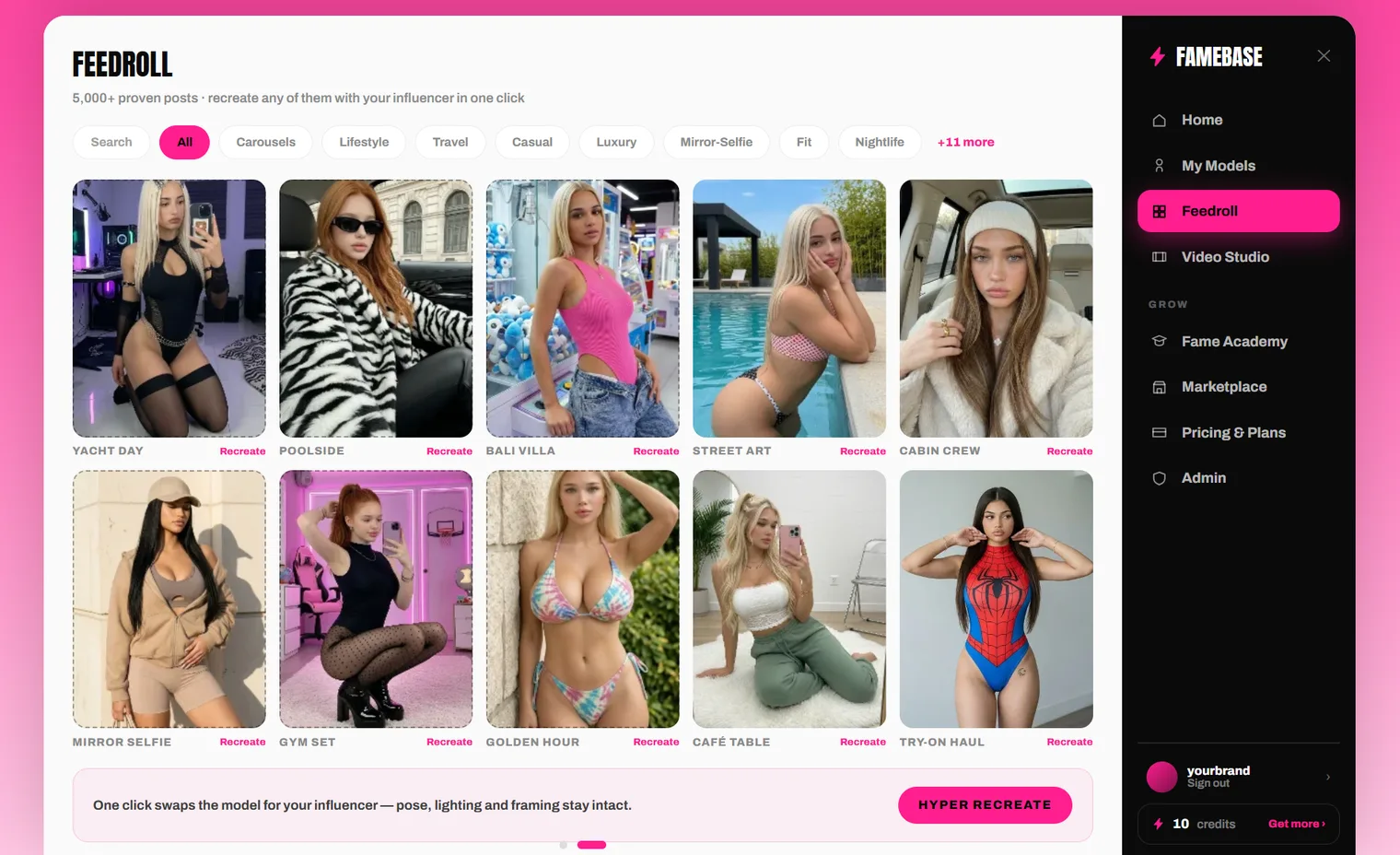
Then you need something to post. Feedroll is a feed of 10,000+ posts, poses, outfits and locations that already worked. Pick one, hit Recreate, and it comes back as your influencer.
What no tool supplies is the list above. The niche, the point of view, the brands you say no to. That part is yours.
Where to start
Pick the example closest to what you want to build, then work out what made it work. It is rarely the rendering.
If you want the steps, the AI influencer guide covers building one end to end, and the Instagram playbook covers a posting week that holds. For the brand side, read Virtual influencers: a practical guide.
Ready to pick a face? Compare plans. Your influencer is included in every one.
Questions, answered
Who was the first AI influencer?
There is no agreed first. Lu do Magalu began in 2003 as the voice of a Brazilian retailer's online shop, and Miquela began as an Instagram profile in 2016. Both predate today's generative AI tools.
Are AI influencers real people?
No. The character is invented, but real people run the account. Every example in this list has a named creator or company behind it.
Do AI influencers work with real brands?
Yes. Imma has worked with IKEA, Noonoouri with fashion houses including Dior, and Rozy fronted a commercial for Shinhan Life.
Do I have to say my influencer is AI?
Treat disclosure as the default. Meta labels AI-generated images it detects or that the poster declares, and rules differ by platform, so check the current policy before you post.
Can I make my own AI influencer?
Yes. On Famebase you can buy a trained 1-of-1 from the Marketplace or upload a character you already have and train it, then create content with Feedroll and Recreate.